
A horse can look almost normal while a tendon is under strain. They may still walk out of the stable keenly, eat well and even feel willing to work, yet a small change in the leg can be the earliest warning that something is wrong. Knowing the five signs of tendon damage gives you the best chance of responding early, protecting the injured area and avoiding the setback that can follow when a horse carries on through pain.
Tendon injuries are frustrating because healing takes time. Tendons have a limited blood supply, and the repaired tissue needs carefully managed loading to become as strong and organised as possible. Prompt veterinary assessment, followed by a consistent rehabilitation plan, is the sensible route. Your daily observations matter too.
Why early tendon changes deserve attention
A tendon connects muscle to bone, helping the horse absorb force and move efficiently. In the lower limb, the superficial digital flexor tendon and deep digital flexor tendon are especially vulnerable to overload, particularly in horses that jump, gallop, work on uneven ground or return to fitness too quickly.
Damage can range from mild fibre strain to a more substantial tear. It is not always dramatic at first. Some horses are clearly lame, while others show only warmth or a slightly different feel in one leg after exercise. Comparing both legs every day, preferably before and after work, helps you notice what is unusual for your horse.
Five signs of tendon damage in horses
1. Heat in the tendon area
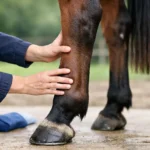
Heat is often one of the first changes an owner notices. Run the back of your hand gently down both legs, comparing the same point on each side. A tendon that feels noticeably warmer than its pair may be responding to inflammation or increased blood flow following strain.
Heat alone does not confirm tendon injury. A warm day, recent exercise or a full stable can make legs feel warmer than usual. The concern is persistent, localised heat, especially when it appears with swelling, sensitivity or lameness. If the leg is hot after work and has not settled with normal rest, stop ridden exercise and speak to your vet.
2. Swelling or a change in the tendon’s outline
A healthy tendon usually has a clean, defined profile. Swelling may make the back of the leg look fuller, softer or less even than the opposite limb. It can be subtle, so use your fingertips as well as your eyes. Feel for thickening along the tendon, a small lump, or a section that seems less clearly defined.
Acute swelling can be obvious, but not every injury produces a large bow. Mild strains may create only slight filling around the tendon sheath or a change that is easier to feel than see. Old injuries can also leave permanent thickening, which is why knowing your horse’s normal legs is so useful.
Do not assume that a small amount of swelling is harmless simply because your horse is not very lame. Ultrasound is often needed to assess tendon fibres properly and establish the right plan for rest, controlled exercise and follow-up checks.
3. Lameness, shortened stride or reluctance to move forward
Lameness can vary widely with tendon damage. A horse may be clearly uneven at trot, take shorter steps, land cautiously or feel less willing to lengthen. On a circle, the change may become more noticeable because the limb is loaded differently. Some horses are only uncomfortable when first coming out of the stable, while others seem worse after exercise.
Behaviour can offer a clue as well. A normally forward horse may resist transitions, object to turning, feel unwilling to pick up a lead, or become tense when asked to work on a surface that previously caused no difficulty. These signs can have many causes, from foot pain to joint issues, so they should never be used to diagnose a tendon problem on their own.
Any new lameness deserves a call to your vet. Avoid lunging, jumping, fast work and repeated “testing” to see whether the horse improves. Continuing to load a damaged tendon can turn a manageable strain into a much longer rehabilitation.
4. Pain or sensitivity when the leg is touched
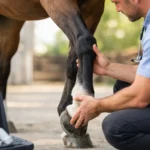
A horse with an irritated tendon may react when you palpate the affected area. They might lift the leg away, tense the limb, turn to look, swish their tail or become unsettled when you run your hand down the tendon. Compare their response with the other leg, using light, calm pressure.
Be careful not to prod repeatedly or deeply. A sore leg needs assessment, not forceful examination. Sensitivity can also be caused by a knock, skin condition, cellulitis or another soft-tissue problem. Nevertheless, pain alongside heat or swelling is a strong reason to stop work and seek professional advice.
Keep a note of when you first noticed the reaction, where it occurs and whether it changes after turnout or exercise. These details can help your vet build a clearer picture, particularly where the physical changes are mild.
5. Stiffness that does not settle as expected
A little stiffness after a hard session can occur, especially in an older horse or one returning to work. Tendon-related stiffness is more concerning when it is repeated, localised or paired with changes in the leg. Your horse may take several minutes to loosen up, move carefully when turning in the stable, or feel short behind or in front after standing.
The key question is whether the pattern is new. If stiffness becomes more frequent, worsens after work or fails to improve with suitable rest, do not write it off as age, weather or a difficult surface. Tendon issues are easier to manage when the workload is adjusted before significant fibre damage develops.
What to do when you spot a warning sign
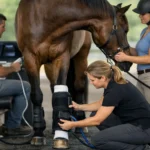
If you see one or more of these signs, pause the horse’s normal exercise immediately. Keep them in a safe, calm environment and follow your vet’s advice on movement, cold therapy, bandaging and pain relief. The right response will depend on the horse, the location of the issue, the severity of lameness and whether the injury is fresh or longstanding.
Veterinary examination and ultrasound are central to a reliable diagnosis. An ultrasound scan can show changes within the tendon that cannot be judged accurately by appearance alone, and repeat scans help guide a gradual return to work. This avoids the common mistake of increasing exercise because the leg looks better before the tendon has rebuilt enough strength.
During rehabilitation, consistency matters more than haste. Controlled walking, carefully planned increases in exercise and regular monitoring all have a role. Take photographs of the leg, make simple notes after each check and report any return of heat, filling or lameness promptly.
Supporting daily tendon care alongside veterinary guidance
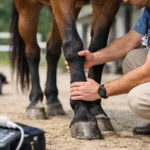
Once your vet has assessed the horse, daily supportive care can be a practical part of the routine. Gentle, non-invasive therapies may help promote circulation, ease stiffness and support comfort around the affected area. They should complement, not replace, veterinary diagnosis, prescribed treatment or a structured rehabilitation programme.
The Horse Tendon Treatment pad is designed for this kind of regular stable-based support. Combining targeted vibration therapy with acupressure, it offers a drug-free option that can be used as part of daily tendon care for horses in recovery or those managing the demands of ongoing work. Its portable design makes it straightforward to fit around grooming, rest periods and post-exercise checks.
Prevention also has a place in the conversation. Sensible conditioning, suitable footing, regular farriery, appropriate warm-up and cool-down time, and avoiding sudden workload increases all reduce unnecessary strain. No treatment pad or management tool can make poor training decisions safe, but a thoughtful routine can help you spot changes earlier and give tendons the care they need.
A tendon injury can feel daunting, particularly when you are looking at months of careful rehabilitation. But calm observation is powerful. Check your horse’s legs often, trust meaningful changes rather than waiting for a major problem, and give your vet the earliest possible chance to protect your horse’s comfort and long-term soundness.