
A check ligament injury can feel particularly frustrating because the horse may look brighter before the tissue is ready for normal work. This guide to check ligament rehabilitation explains how to protect healing tissue, monitor genuine progress and build a calm, consistent routine alongside your veterinary team.
The aim is not simply to get swelling down or make your horse comfortable enough to move more freely. It is to give the ligament the time and controlled loading it needs to heal in an organised, resilient way. Rushing that process can turn a manageable injury into a longer-term weakness, especially in horses returning to demanding work.
Understanding the check ligament injury
The check ligaments sit in the lower limb and support the function of the superficial and deep digital flexor tendons. They help control the strain placed on these tendons as the horse moves. An injury may involve inflammation, fibre disruption or a more substantial lesion, and it can occur after fast work, an awkward movement, accumulated workload stress or a single overextension.
Some horses show clear heat, filling, sensitivity or lameness. Others are much more subtle. You may notice a shortened stride, reluctance to stretch forward, reduced performance or a limb that repeatedly fills after exercise. A horse can also appear sound in a straight line while still being uncomfortable on a circle or on uneven ground.
Because the signs can overlap with tendon, suspensory and joint problems, a veterinary assessment is the starting point. Ultrasound imaging is often used to identify the affected structure, assess the extent of damage and provide a baseline for future comparison. This matters because a small strain and a significant core lesion should not follow the same rehabilitation timetable.
The first stage: protect, assess and settle the limb
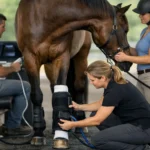
In the early phase, the priority is limiting further damage while inflammation settles. Your vet may advise box rest, restricted turnout, cold therapy, supportive bandaging or medication where appropriate. Follow those instructions closely, even if your horse is finding rest difficult. Controlled management early on can protect months of future progress.
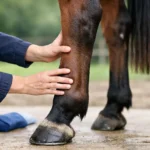
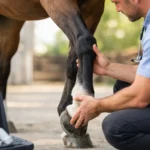
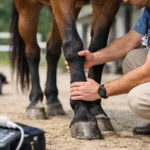
Check the limb at roughly the same time each day. Compare it with the opposite leg and take note of heat, localised swelling, response to gentle palpation and how the horse walks out. A brief written record is more useful than relying on memory, particularly when several people handle the horse at the yard.
Avoid repeatedly pressing or testing the injured area. You are looking for trends, not trying to diagnose the injury yourself. A sudden increase in heat, swelling, pain, lameness or digital pulse warrants a call to the vet, especially if it follows an increase in exercise or turnout.
Keep the routine predictable
Rest can be difficult for an active horse, so keep stable management calm and familiar. Regular forage, safe enrichment and sensible handling reduce stress without encouraging sudden movement. If controlled turnout is approved, use the size and surface your vet recommends rather than assuming a larger field will help the horse relax.
Foot balance also deserves attention. An uneven or overdue trim can change how forces travel through the lower limb. Your vet and farrier may recommend a particular shoeing or trimming approach, but this should be individual to the horse and injury rather than copied from another rehabilitation case.
Controlled exercise builds useful strength
Ligaments do not benefit from complete inactivity forever. Once your vet is satisfied that the acute stage has passed, carefully controlled exercise helps healing fibres adapt to load. The key word is controlled. The work must be regular enough to stimulate recovery, but quiet enough that it does not overload immature tissue.
Most plans begin with in-hand walking on a firm, level surface. Duration usually rises in small increments over weeks, not in large jumps after a good day. Straight lines are generally easier on the healing structure than tight circles, deep going, sharp turns or excitable turnout. Your vet’s plan takes priority over any standard schedule because location, lesion size, age, temperament and previous injuries all affect the right pace.
As healing progresses, reassessment often guides the next step. This may mean longer walking, then introducing short periods of trot, and later canter, poles, schooling or sport-specific work. Each transition should be earned through comfort, consistent limb condition and professional review. A horse that is keen to do more is not necessarily ready to do more.
What progress should look like
Good rehabilitation is often uneventful rather than dramatic. You want to see a limb that remains cool and settled after the prescribed exercise, a horse that moves evenly, and gradual improvement in strength and confidence. Follow-up imaging may show whether the tissue is filling in and aligning as expected.
There will be small variations. A warm day, more time standing in, travel or a change in turnout can cause mild filling. What matters is whether it resolves promptly and whether it is accompanied by pain or altered movement. When in doubt, reduce activity to the last comfortable level and seek advice before progressing.
Daily care that supports check ligament rehabilitation
A successful plan is built into ordinary stable life. Consistent grooming gives you an opportunity to notice changes. A measured walking programme makes loading more predictable. Careful records help your vet, physio, farrier and trainer understand what has changed when a horse improves or has a setback.
Supportive therapies may also have a place when used as an addition to, rather than a replacement for, diagnosis and prescribed rehabilitation. Gentle methods that promote circulation, reduce stiffness and encourage relaxation can be particularly useful while a horse is restricted and when workload begins to increase. They should never be used to mask pain and push a horse beyond its stage of healing.
Horse Tendon Treatment’s pad uses targeted vibration therapy and acupressure as a practical, drug-free addition to daily tendon and ligament care. Used in line with professional advice, a portable therapy routine can help owners give regular comfort and circulation support without making rehabilitation more complicated.
Nutrition should be sensible rather than extreme. Horses on reduced exercise may gain weight quickly, increasing load on already vulnerable limbs. Keep forage as the foundation of the diet, adjust calories with professional guidance where necessary, and ensure the horse receives balanced vitamins and minerals. There is no single supplement that can replace time, controlled exercise and sound management.
Mistakes that can delay recovery
The most common error is allowing the horse’s attitude to dictate the programme. A horse may feel fresh, look sound and be desperate to return to normal turnout well before the ligament has regained adequate strength. The second is adding several changes at once, such as more turnout, longer walking and new shoeing. If the leg reacts, it becomes difficult to know what caused the problem.
Be cautious with surfaces too. Deep, holding arenas and uneven tracks increase strain, while hard ground may be unsuitable at certain stages or for particular horses. Weather can change footing quickly in Britain, so adjust the day’s plan rather than following it rigidly.
Finally, do not treat a quiet period as a reason to stop monitoring. Check ligament injuries can be slow to declare themselves again. Regular hands-on checks, patient progression and scheduled veterinary reviews offer far more protection than waiting for obvious lameness.
Returning to normal work without losing the gains
The final stages of rehabilitation need the same discipline as the first. Build fitness before asking for intensity. A horse returning to hacking may progress differently from a showjumper, eventer or racehorse, but every horse benefits from a gradual increase in duration, surface variation and technical demands.
Introduce one new challenge at a time. For example, establish comfortable trot work before adding circles, and establish balanced schooling before introducing faster work, jumping or competition travel. Keep monitoring the limb after exercise and the following morning, when a reaction may be easier to spot.
A check ligament injury asks for patience, but patient care is active care. Each quiet walk, thoughtful limb check and sensible decision to hold a level for another week helps give your horse the best chance of returning to comfortable, confident movement.