
A horse can feel bright, comfortable and eager to work long before a healing tendon, ligament or joint is ready for the demands of collected trot or a balanced canter transition. That gap is the hard part of dressage horse injury recovery. It asks riders to trade the satisfaction of doing more today for the far greater reward of a sound, confident horse next season.
Dressage places repeated, precise load through the limbs. Circles, lateral work, transitions and collection all require strength, symmetry and suppleness. When injury interrupts that work, recovery should be planned around the tissues involved, the horse’s history and their future workload – not simply the date on the calendar.
Start with a clear diagnosis and a calm plan
Tendon injuries, suspensory strains, ligament damage, joint inflammation and muscular compensation can look similar from the stable door. A little heat, a shortened step, reluctance to bend or a loss of impulsion may be early clues, but they do not tell you what is happening beneath the skin.
Veterinary assessment is the starting point. Depending on the concern, this may include palpation, flexion tests, scans, X-rays or further imaging. A diagnosis gives your recovery plan a purpose: protecting injured tissue while gradually restoring the movement and strength needed for dressage.
It is tempting to compare your horse’s timeline with another horse at the yard. That rarely helps. The severity and location of an injury, the horse’s conformation, age, previous soundness and response to rest all influence recovery. A mild strain may settle relatively quickly; a significant tendon lesion can require many months of carefully managed rehabilitation.
Your vet and physiotherapist should guide the programme, particularly when deciding when to introduce turnout, trotting, canter work and schooling. Consistency between everyone involved – owner, rider, groom, farrier and professionals – makes a meaningful difference.
The first stage of dressage horse injury recovery
The early phase is about settling the injury and avoiding the setbacks that turn a manageable problem into a prolonged one. This may mean box rest, restricted turnout or controlled walking, according to veterinary advice. It can be mentally demanding for a fit dressage horse, so stable management matters as much as the exercise plan.
Keep routines predictable. Good forage provision, suitable companionship where possible and safe ways to occupy the horse can reduce stress without encouraging exuberant movement. Review feet regularly too. Balanced, appropriate trimming or shoeing supports even loading through the limbs and should form part of the wider rehabilitation discussion.
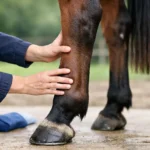
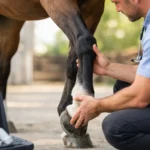
Daily observation is valuable, but it should be methodical rather than anxious. Check the affected leg at the same time each day and compare it with the other limb. Look for changes in heat, swelling, sensitivity and digital pulse, and note how the horse moves in hand if they are permitted to walk.
Contact your vet promptly if you see any of the following:
- New or increasing heat, swelling or tenderness in the affected area.
- A return of unevenness, shortened stride or reluctance to bear weight.
- Sudden behavioural changes during handling or controlled exercise.
- Swelling that appears higher or lower in the leg than the original injury.
A small change is not always a crisis, but it is always worth taking seriously. Carrying on in the hope that it disappears can cost valuable rehabilitation time.
Support healing without trying to rush it
Recovery needs adequate rest, but complete inactivity is not the same as good rehabilitation. At the right point, carefully prescribed movement helps tissues adapt to controlled load. Walking programmes often begin with short, straight lines on firm, even ground, then build slowly over weeks.
The key word is controlled. Tight turns, deep footing, uneven surfaces and an enthusiastic spin at the end of the lead rope can place more strain on a recovering limb than the planned walk itself. If your horse is feeling fresh, discuss safe management options with your vet rather than taking risks to get through the programme.
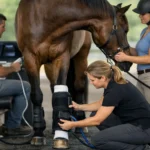
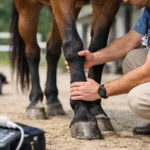
Alongside prescribed exercise, daily tendon care can help support comfort and circulation around hardworking legs. A drug-free, non-invasive therapy pad using targeted vibration and acupressure can fit simply into the stable routine, providing gentle support for stiffness and recovery without replacing veterinary treatment. Horse Tendon Treatment is designed for this practical role: easy to use at home, portable and suitable for ongoing care during rehabilitation or after work.
The right supportive therapy should feel like an addition to the plan, not a shortcut around it. No pad, bandage, supplement or treatment can make damaged fibres ready before they have healed and strengthened. Used consistently alongside professional guidance, however, a straightforward daily routine can give owners a constructive way to care for their horse between appointments.
Rebuilding the body for dressage work
A horse returning from injury does not just need a sound leg. They need a body capable of carrying themselves evenly. During time off, strength can fall away through the core, hindquarters and topline. Compensations may also have developed before the injury was diagnosed or while the horse was protecting the affected area.
This is why the first trot sets in a rehabilitation plan should be treated as information, not a test of enthusiasm. Start exactly as advised, often in brief intervals on suitable straight ground, and assess how the horse feels during and after the session. Any increase in heat or filling, change in stride, or reluctance the following day needs recording and discussing.
Straightness comes before collection
In early ridden work, favour rhythm, relaxation and straightness. Large lines and an honest, forward walk provide a foundation before more demanding exercises. A horse that can move freely forward without tension is in a better position to develop the strength required for later work.
Collection increases load through the hindquarters and can alter forces through the entire body. It should return only when the horse is established in simpler work and your professionals are satisfied with their progress. The same applies to frequent transitions, smaller circles, shoulder-in, travers and counter-canter. These are excellent gymnastic exercises for a healthy, prepared horse, but they are not the place to prove an injured horse is better.
Let the horse set the honest pace
Dressage riders are trained to notice detail, which is an advantage during rehabilitation. Watch for a tail that swishes only on one rein, a change in contact, loss of swing through the back, resistance to a particular transition or difficulty tracking up. None of these signs confirms reinjury on its own, but patterns are useful evidence.
Keep a simple diary of exercise duration, surface, turnout, therapies and observations. Photographs of the leg can also help you spot changes that are hard to judge from memory. This record gives your vet or physiotherapist a clearer picture and prevents well-meaning adjustments becoming guesswork.
Manage the return to competition carefully
Being sound at home is not automatically the same as being ready for a test environment. Travelling, standing on the lorry, unfamiliar stables, firmer warm-up areas and the rider’s understandable nerves can all increase physical and mental pressure.
Before entering a competition, consider whether your horse can complete their normal work comfortably, recover well afterwards and cope with a few different environments without becoming tense. A quiet outing, arena hire or low-pressure training session may be a better first step than aiming immediately for a demanding class.
Surface choice deserves attention throughout this stage. Deep, holding or inconsistent going can challenge a recovering limb, while very firm ground may increase concussion. There is no single perfect surface for every horse, but predictable, well-maintained footing is usually the sensible choice. Build intensity one variable at a time: duration, complexity, collection, travel or competition exposure – not all at once.
Make prevention part of the new routine
The most useful lesson from an injury is often that tendon care belongs in everyday management, not only in an emergency. Warm up thoroughly, cool down with purpose, avoid drilling the same movements and give the horse easier days after demanding work. Regular checks of leg condition, saddle fit, feet, fitness and arena surface help identify pressure points before they become larger problems.
A careful return can feel slow when you miss schooling and competition, but patience is active care. Each quiet walk, accurate note and sensible decision gives your dressage horse the best chance to return not merely sound, but stronger, more comfortable and ready to enjoy their work again.